Art is subjective. It's purely interpretational, and I think the best art knows how to bend interpretation to convey its own emotion. You never know what the audience is thinking, and as such, simply telling them how to feel will never get you anywhere. There's different forms of this concept in every form of media. The most well known is the concept of "show, don't tell". Forcing the audience to process, to participate in the art, will make them feel deeper emotions. This, in turn, make them more invested. It is why an aura of mystery is so effective.
Poetry
I was forced to take an extra class my freshman year of college. Feeling a little artsy (and pretentious), I decided to take a poetry foundations course. Holy mackerel! That was the hardest class I ever took! I had no idea the english language was so complicated. I legit got lost on the first day, and never truly caught back up. I learned a lot of valuable stuff in that class. One of my favorites being to speak in your own voice. DURR! That's kinda obvious, but actually... it's not so. You see, when most people think about poetry, they think of old stuff, like 200+ year old Shakespeare stuff.
"When in disgrace with fortune and men’s eyes I all alone beweep my outcast state,"
- Emo Shakespeare
They read it, they study it in school, then they're told to write some poetry. Now all of a sudden everyone is out here speaking broken old english and sounding like knockoff Emo Shakespeare, missing the whole point. Poetry isn't fancy old english, Shakespeare's poems are like that because that's how people talked back in the day. Modern poetry requires a modern dialect to speak of your own lived experience. Here's my absolute favorite modern example:
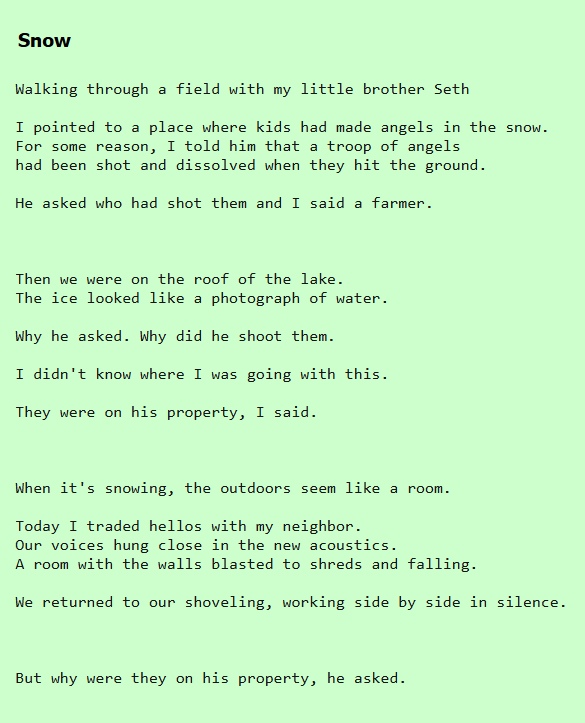
That poem was written by David Berman of the band Silver Jews. Notice how he's talking simply, almost as if in a conversation, and yet, it is so impactful. A lot of the impact, coming from invisible details hidden in the very shape of the poem: the pauses, the line breaks, even the punctuation. It all contributes immensely.
Music
Oh yeah, this blog post was also about music! I'm critical of lyrics in music. If I hear a line that's "cringe", then I'm instantly hating the entire song. That's just me though. The easiest way a musician can do that is by making an emotional song with a clear lack of emotional intelligence. I'd give an example, but I promised Adeline and Angel that I'd stop being a hater. Oopsies. Anyway, remember how I said something along the lines of "The shape of the poem contributes greatly to the emotional impact"? The same goes for music. The shape of the song should fit the message: The form should fit the message(that's a big deal). Pauses, volume changes, chord changes, section order, all add impact to every word. Instruments can symbolize when in tandem with a story beat. Change can be heard and felt through the addition of extra instruments/notes/chords as the song progresses. It usually isn't that intensive, but it can be. I think my favorite example would be 'Semi-Chamred Life' by Third Eye Blind. The emotional core of the song is made melancholic through the juxtaposition of upbeat instruments and jarring lyrics. That's the emotion the authors want to convey, and it's only through deliberate manipulation that they can achieve it.